目录

  • Ch01: The Foreign Exchange Market
    • ● 1.1 Foreign Exchange Trading
    • ● 1.2 Spot  Exchange Rates
    • ● 1.3  Currency Arbitrage
    • ● 1.4  Foreign Exchange Rate Movements
    • ● 1.5 Trade-weighted Exchange Rate Indexes
    • ● 1.6 Chapter Review
  • Ch02: International Monetary Arrangements
    • ● 2.1 The Gold Standard & Bretton Woods Agreement
    • ● 2.2 The Current International Monetary System
  • Ch.03: The Balance of Payments
    • ● 3.1 Current Account & Capital Account
    • ● 3.2 Transactions Classifications
    • ● 3.3 Balance of Payments Equilibrium and Adjustment
  • Ch04: Forward-looking Market Instruments
    • ● 4.1 Forward Rates
    • ● 4.2 Swaps
    • ● 4.3  Futures
    • ● 4.4 Options
  • Ch05: The Eurocurrency Market
    • ● 5.1 Reasons for Offshore Banking & Libor
    • ● 5.2 International Banking Facilities & Offshore Banking Practices
  • Ch6: Exchange Rates, Interest Rates, and  Interest Parity
    • ● 6.1 Interest Parity
    • ● 6.2 Exchange Rates, Interest Rates, and  Inflation
    • ● 6.3 Expected Exchange Rates and the Term Structure of Interest Rates
  • Ch07: Prices and Exchange Rates:  Purchasing Power Parity
    • ● 7.1 Absolute Purchasing Power Parity
    • ● 7.2 Relative Purchasing Power Parity
    • ● 7.3 Overvalued and Undervalued Currencies
    • ● 7.4 Chapter Review
  • Ch08: Foreign Exchange Risk and Forecasting
    • ● 8.1 Types of Foreign Exchange Risk & Foreign Exchange Forecasting
  • Ch09: Determinants of the Balance of Trade
    • ● 9.1 Elasticities Approach to the Balance of Trade
    • ● 9.2 The Absorption Approach & Monetary Approach
  • Reviews
    • ● Key Points
  • Electronic Learning Materials
    • ● E-Textbook
    • ● Reference Book
6.2 Exchange Rates, Interest Rates, and  Inflation
  • 1 基本概念
  • 2 PPT

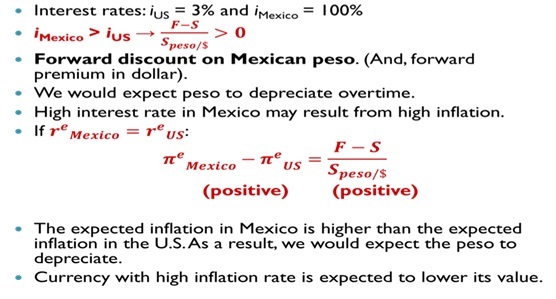
Ⅲ Interest rateand inflation: Fisher equation

A. Fisher equation
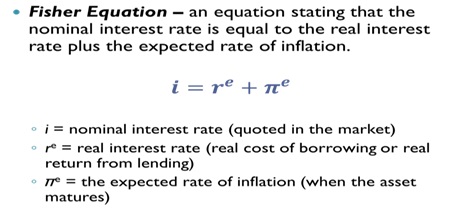
B. Real Interest Rates Equalization

If we expect the real interest rate to behigh in a particular country, then investors would move investment funds intothat country. Therefore, we would predict that expected real interest rateswill be equalized across countries.

  • From this data, we would anticipate more capital flow into Brazil.

  • As investment funds leave the U.S. → sell bonds in U.S. causing rUS torise → buy bonds in Brazil causing rBRAZILto fall → rUS = rBRAZIL

Note that this is a speculative condition,but not an arbitrage condition. Thus, it does not need to hold.

C. Connecting Fisher Equation to CIRP
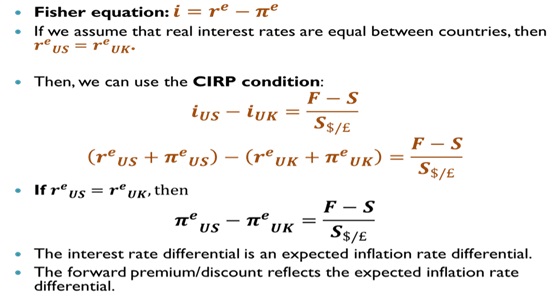
  

D. Example: