
目录

  • Ch01: The Foreign Exchange Market
    • ● 1.1 Foreign Exchange Trading
    • ● 1.2 Spot  Exchange Rates
    • ● 1.3  Currency Arbitrage
    • ● 1.4  Foreign Exchange Rate Movements
    • ● 1.5 Trade-weighted Exchange Rate Indexes
    • ● 1.6 Chapter Review
  • Ch02: International Monetary Arrangements
    • ● 2.1 The Gold Standard & Bretton Woods Agreement
    • ● 2.2 The Current International Monetary System
  • Ch.03: The Balance of Payments
    • ● 3.1 Current Account & Capital Account
    • ● 3.2 Transactions Classifications
    • ● 3.3 Balance of Payments Equilibrium and Adjustment
  • Ch04: Forward-looking Market Instruments
    • ● 4.1 Forward Rates
    • ● 4.2 Swaps
    • ● 4.3  Futures
    • ● 4.4 Options
  • Ch05: The Eurocurrency Market
    • ● 5.1 Reasons for Offshore Banking & Libor
    • ● 5.2 International Banking Facilities & Offshore Banking Practices
  • Ch6: Exchange Rates, Interest Rates, and  Interest Parity
    • ● 6.1 Interest Parity
    • ● 6.2 Exchange Rates, Interest Rates, and  Inflation
    • ● 6.3 Expected Exchange Rates and the Term Structure of Interest Rates
  • Ch07: Prices and Exchange Rates:  Purchasing Power Parity
    • ● 7.1 Absolute Purchasing Power Parity
    • ● 7.2 Relative Purchasing Power Parity
    • ● 7.3 Overvalued and Undervalued Currencies
    • ● 7.4 Chapter Review
  • Ch08: Foreign Exchange Risk and Forecasting
    • ● 8.1 Types of Foreign Exchange Risk & Foreign Exchange Forecasting
  • Ch09: Determinants of the Balance of Trade
    • ● 9.1 Elasticities Approach to the Balance of Trade
    • ● 9.2 The Absorption Approach & Monetary Approach
  • Reviews
    • ● Key Points
  • Electronic Learning Materials
    • ● E-Textbook
    • ● Reference Book
7.2 Relative Purchasing Power Parity
  • 1 基本概念
  • 2 PPT
  • 3 自我测试

Ⅳ Relative Purchasing Power Parity

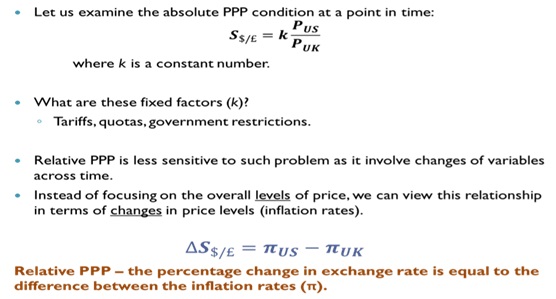
Absolute PPP – the exchange rate equals to the ratio of price levels between twocountries.

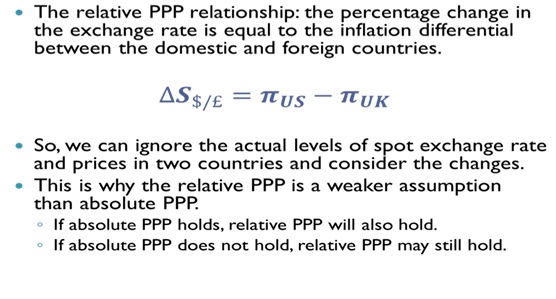
Relative PPP – the percentage change in the exchange rate equal to the inflationdifferential between two countries.

Relative PPP is a weaker condition than theabsolute PPP.

It holds better in the short run thanabsolute PPP.

A. From Absolute PPP to Relative PPP
 

B. Relative PPP
 

C. Deviations from PPP

It seems that there are many currencies withlarge over- or under-valuations from implied PPP exchange rates.

Questions:

  • Does PPP not hold?

  • Are these countries manipulating their currencies?

  • Is there anything wrong about using Big Mac as a benchmark commodity fortesting PPP?

Does Absolute PPP hold?

Sometimes. We see substantial deviations from PPP.

Reasons:

  • Differentiated products (not comparable between countries)

  • Transaction costs (information and transportation costs are differentacross countries)

  • Trade barriers (ex. tariff, quota, etc.)

  • Some goods are not tradable across borders (so low arbitrage activities)such as services.

  • Local regulations and taxes

  • Consumer preferences differ in different countries.

The PPP equilibrium seldom exists
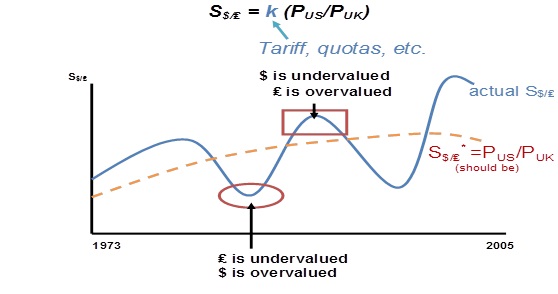


The general PPP concept is not as likely tohold perfectly as the LOP.