1.To have a discussion that elicits expressions relating to being out of money;
2.To increase the familiarity and use of such expressions;
3.To translate the visual information from the video clip into the appropriate language;
4.To use the audio information in the corresponding exercises;
5.To reinforce productively the language that has been learned.


● Think about the following questions and try to answer them.
1) What do you say when you are out of money?
2) What should you do when you are out of money?
3) Can you guess whose pockets are empty in the picture?
* suggested answers:
1) I can say, “I have no money.” I can also say, “I’m penniless.”
2) I can get a part-time job.
3) I think Michael’s pockets are empty.

● The following expressions can be used to state that you are out of money. Listen and complete the sentences below with the missing words.
1) I’m broke.
2) I’m flat broke. / I’m dead broke.
3) I’m bankrupt.
4) I’m busted.
5) I’m flatter than a pancake. (informal)
6) I don’t have a dollar/penny/cent to my name.
7) I’m as poor as a church mouse. (idiomatic)
8) All I have left is the shirt on my back.
9) I don’t know where my next meal is coming from.
10) My savings are wiped out.

在日常生活中,人总会有一贫如洗或经济困难的时候,这也就决定了有表达该状况的需要。当然,各种文化在这方面有其独特的语言表达特点。在汉语里有:身无分文、一贫如洗、青黄不接、两手空空、穷得揭不开锅、吃了上顿没下顿、穷得叮当响、穷光蛋,等等。英语里的表达也同样丰富多彩,其中一个很大的特点是隐喻(metaphor),例如:“I’m flatter than a pancake”; “I’m as poor as a church mouse”; “All I have left is the shirt on my back”; “ I don’t know where my next meal is coming from”。在把这些英语表达翻译成汉语时,应考虑汉语的文化背景,不要逐字逐句直译。


special | 特价品 |
water | 流口水 |
I'm dead broke. | 我一个子儿也没有了。 |
to tell the truth | 老实说 |
cut corners | 节省时间(或金钱) |
bulletin board | 布告牌 |
student loan | 学生贷款 |
apply for | 申请 |
make it | 成功 |
know the ropes | 懂得诀窍 |
paycheck
| 付薪金的支票,薪金 |
Looking forward to it.
| 期待那一天(早日到来)。 |

● Watch the video and then complete the following passage based on your observations.
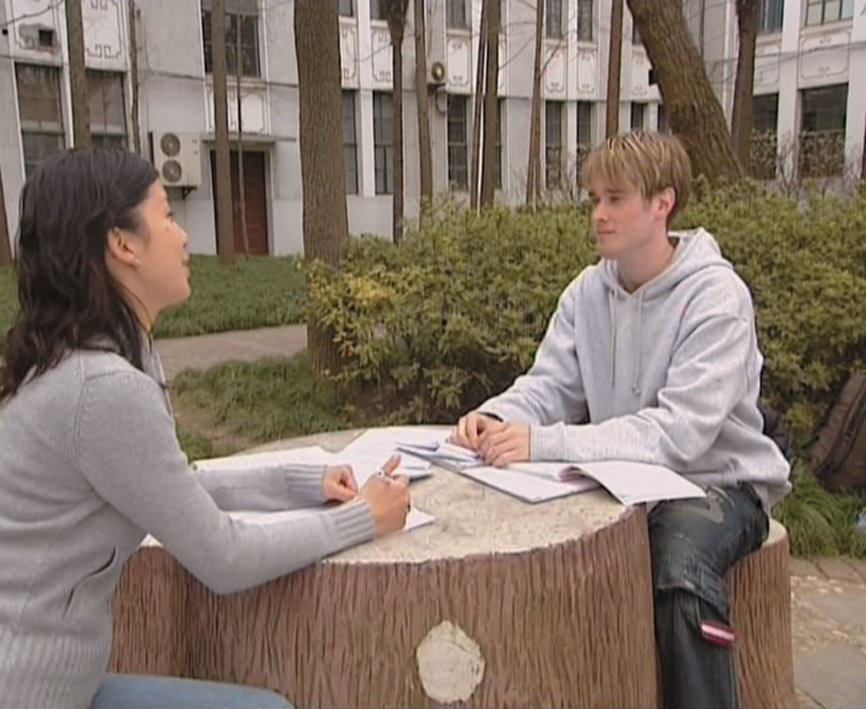
It is a crisp (凉爽的) afternoon. Shelley and Michael are sitting at a garden table, engrossed (全神贯注的) in their studies. A moment later, they begin to chat. Speaking of money, Michael looks worried about his financial situation. Concerned, Shelley tries to be supportive, and ultimately Michael seems optimistic about his future.

A. Watch the video and then decide whether each of the following statements is true (T) or false (F).
1) A new restaurant has recently opened near the school. (T)
2) Shelley and Michael are talking about their favorite foods in the restaurant. (F)
3) Michael doesn’t feel like eating out because he’s broke. (T)
4) Shelley decides to help Michael get a student loan from a bank. (F)
5) Michael is looking for a part-time job on campus just to make ends meet. (T)
B. Now watch the video again and then complete the following conversation.
Shelley:Hey, Michael, you know, there’s a new restaurant near school that has just opened up. They say it has a special on weekdays. It’s time for lunch. Shall we give it a try?
Michael:My mouth is beginning to water. But I’m out of money. In fact, I’m dead broke.
Shelley:What? What did you say?
Michael:I said my pockets are empty.
Shelley:Oh really?
Michael:To tell the truth, I spent so much on textbooks that now I have to cut corners.
Shelley:Did you? How can you go on like this? Are you going to try and get a student loan?
Michael:Maybe, maybe not. I don’t know. But now I’m looking for a part-time job on campus.
Shelley:Are there any part-time job offers on the bulletin board?
Michael:Yes. I’m applying for one. They’re interviewing me this afternoon.
Shelley:Are you going to prepare for the interview?
Michael:Oh, I know the ropes all right.
Shelley:I know you’re a determined person. I’m sure you’ll make it.
Michael:Thanks. We can celebrate when I’ve got a paycheck.
Shelley:Promise?
Michael:I sure do.
Shelley:Looking forward to it.
Michael:You bet.
C. After watching the video a third time, complete the following third-person account of the conversation.
Shelley and Michael meet each other on campus. Shelley informs Michael of a new restaurant that has just opened up near their school. She asks Michael to join her for a lunch special at the restaurant. Michael doesn’t feel like going there because he is out of money. He has spent so much on his textbooks that he has to cut corners now. To make ends meet (收支平衡) , he has been looking for a part-time job on campus. Shelley is confident of his persistence and wishes him success. And Michael promises Shelley that they will dine out to celebrate when he gets a paycheck.

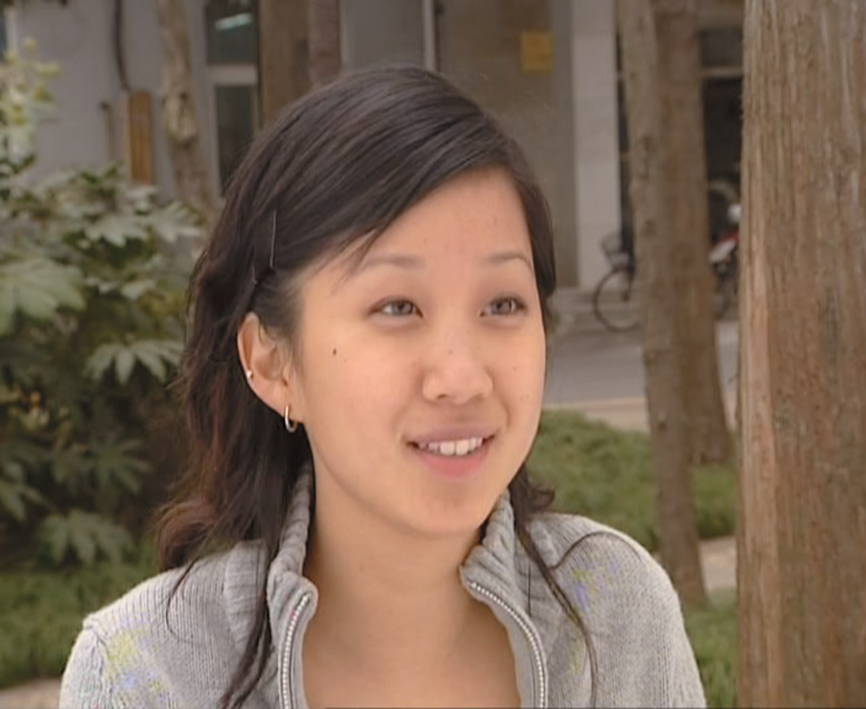
1) Watch the video again, with a female student doing Shelley’s voice.
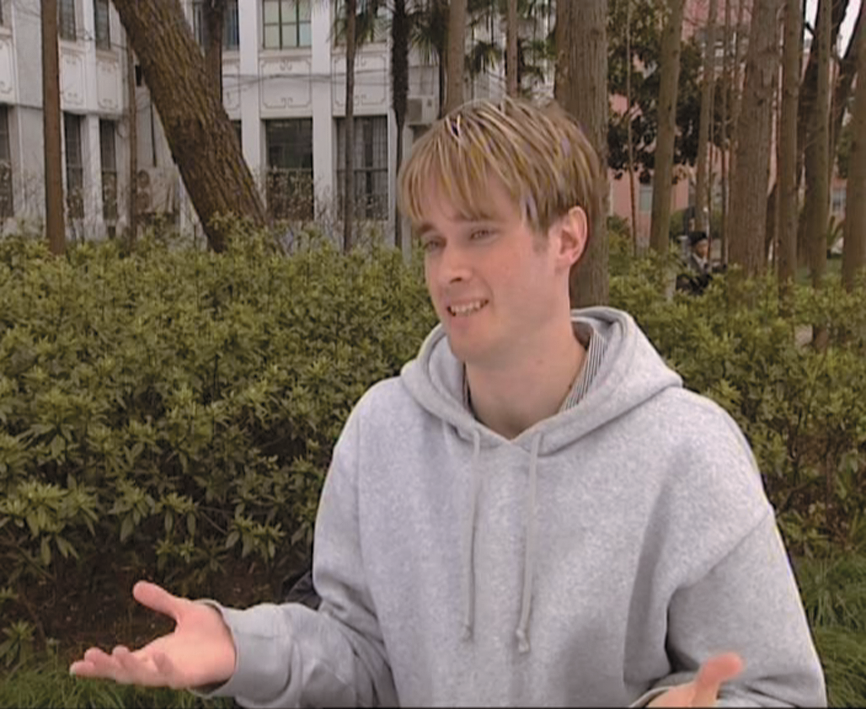
2) Watch the video once more, with a male student doing Michael’s voice.
3) Watch the video one last time, with a male student and a female student doing both of the voices for the whole conversation.

● 1. In the spaces given below, write down some of the useful expressions you have just learned to state that you are out of money. Try to use them when you are asked to take part in an activity that costs money.
1) I’m flat/dead broke.
2) I’m bankrupt.
3) I don’t have a dollar/penny/cent to my name.
4) I’m as poor as a church mouse.
5) All I have left is the shirt on my back.
* suggested dialogue:
A: Thank you for inviting me. I’d really love to go out for dinner, but …
B: But what?
A: You know, practically all I have left is the shirt on my back. No kidding.
B. Oh really?
A: I wish I could afford it, but there’s just no way.
B: Come on. Don’t worry. It will be my treat.
● 2. Discuss the following topics in groups.
1) Money is the root of all evil.
2) Whether you’re rich or poor, it’s nice to have money.
* suggested answers:
1) In this world, many forms of evil have something to do with money. Money can make people selfish. Money can make people greedy. Money can make people crazy. Money can make people cunning (狡诈的) . Money can make people unethical.
2) We are living in the world of reality. We have to survive. We have to pay for our basic necessities — our food, shelter, clothing, etc. We cannot do without money. Money can better our lives. Don’t you think it’s nice to have money, whether you’re rich or poor?

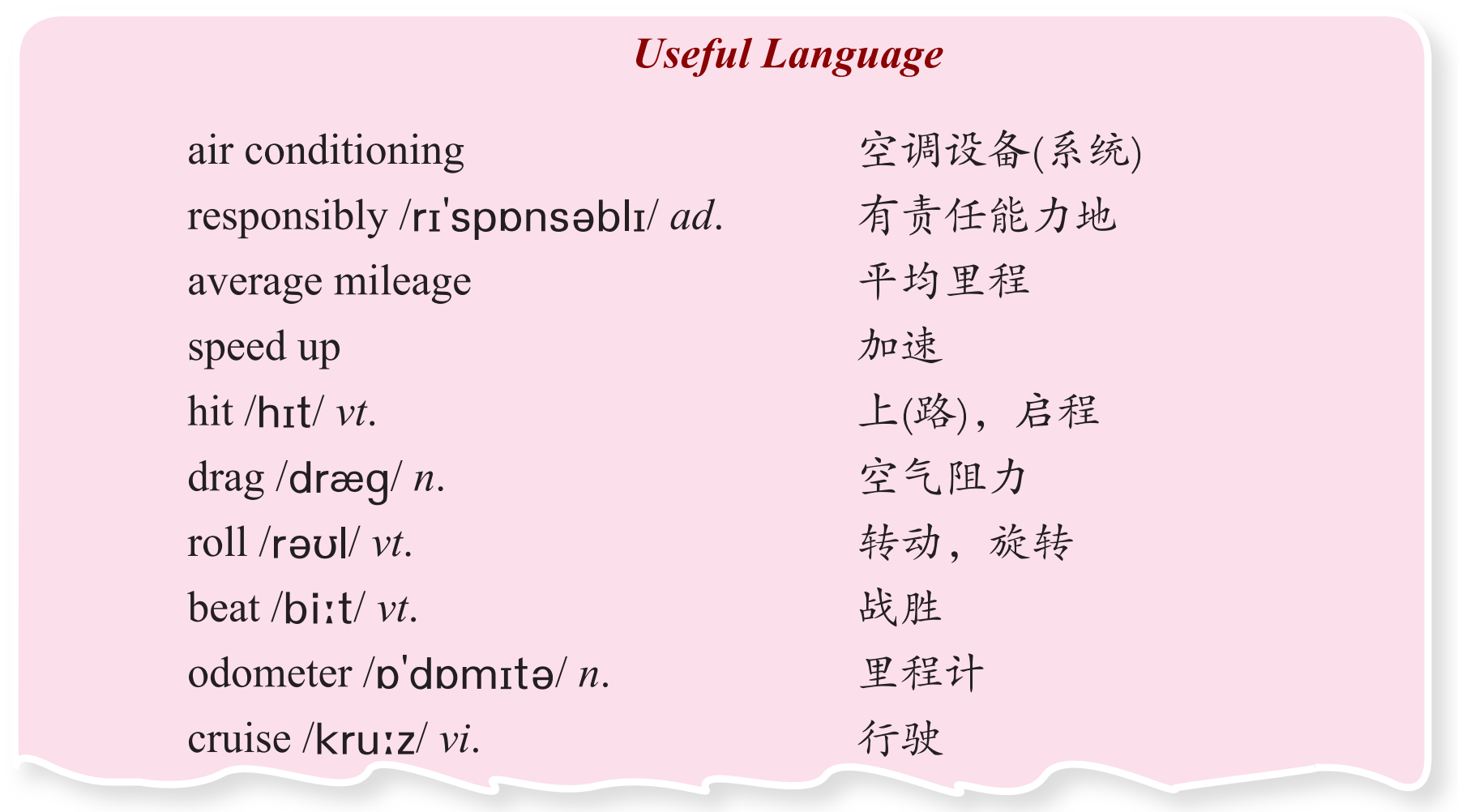
A. You will continue to watch a video clip. Below are suggested steps for the learning activities:
Go through the list of the useful words and expressions;
Watch the video to catch the message;
Complete the table according to the experiment;
Watch the video again;
Make a short oral presentation on the experiment.
B. Complete the following chart based on the video information.
WEATHER | PLACE | WINDOWS | SPEED |
On a hot day | Neighborhood | Down | 45 miles and below |
Highway | Up | 55 miles per hour and more |
CONCLUSION: Using your car’s air conditioning responsibly could increase your average mileage by as much as 20 percent.
* Script:
Did you know using your car’s air conditioning responsibly could increase your average gas mileage by as much as 20 percent? On a hot day, driving around the neighborhood with your windows down feels great, and studies show it also saves your car precious fuel at speeds of 45 and below.
But when you hit the highway, traveling 55 miles per hour or more creates a lot drag on your vehicle to cause your mileage to suffer. So be sure to roll those windows up. So the next time you need to beat the heat while driving, check this odometer to be sure you’re cruising to savings.